Skip to content

Practice

Courses.

Zhineng Qigong in Lampedusa, all year round. For every age, for every practice level.

Practice Centre open all year

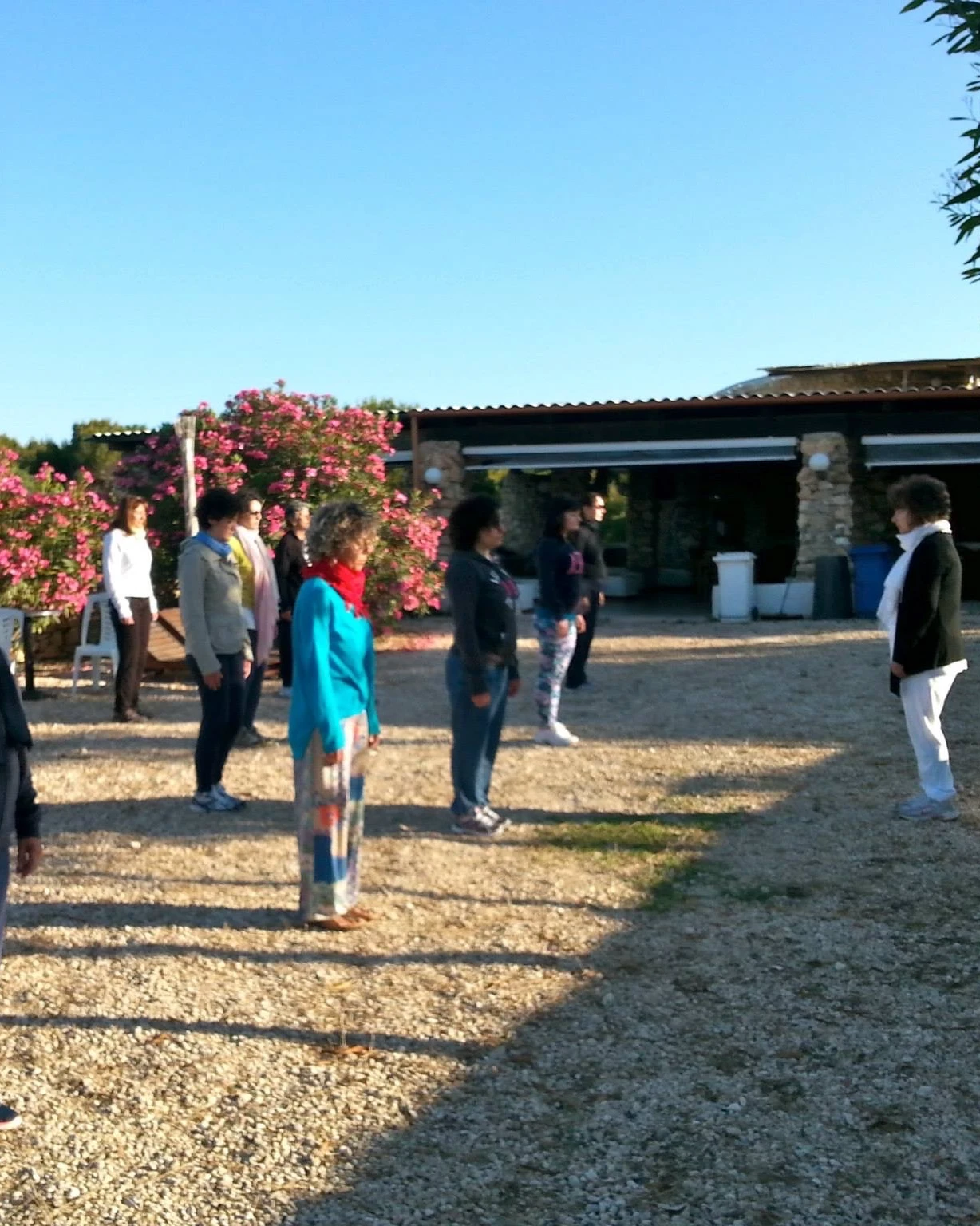
The Southern European Zhineng Qigong Centre at La Roccia Lampedusa offers 365 days of the year practice areas. Time and space to dedicate to your practice and to yourself. For everyone who needs time, space and the technique for healing. Guaranteed practice areas in full contact with pure clean elements and nature. Guaranteed practice company and/or tuition. Practice and tuition taken in English or Italian.

Group practice in Lampedusa

The effects of Qigong on the body

The practice of qigong rebalances the yin-yang aspect in the body, harmonizes qi and blood, cleanses the meridian system, accumulates internal qi and strengthens life. The old and the weak become strong, while the sick recover. All of this has been proven by millions of practitioners and even by medical science.

(i)

The effect on the nervous system

The practice of qigong can repair and regulate the nervous system. During practice the electroencephalogram shows an increase in α waves that radiate from the occipital lobe located at the back toward the front with concentration on the frontal lobe. And this is different from when α waves concentrate in the occipital lobe because we are at rest with our eyes closed. The left and right hemispheres synchronize and this is a sign that the functions of the brain have become more ordered. This regulates the involuntary nervous system and improves the function of perception so as to react intuitively and think systematically.

In the early years of the 2000s, Richard Davidson of the University of Wisconsin in the city of Madison used “brain imaging”1 techniques to show that meditation shifts the activity of the brain in the prefrontal cortex (right behind the forehead) from the right hemisphere to the left hemisphere. His research suggests that through regular meditation the brain turns from a mode of stress to one of acceptance, a change that increases fulfilment. People who have a negative disposition have brain activity in the right prefrontal area, while people with brain activity in the left prefrontal area have more enthusiasm, more interests, are more relaxed and tend to be happier.2

The practice of qigong improves the blood circulation of the heart, the vessels and the capillaries by lowering the level of estradiol in the blood: a sign of an anti-ageing effect.

During practice the consumption of oxygen and the expulsion of carbon dioxide both decrease. This reduces respiratory cycles per minute and significantly improves lung function. In 1967 Dr. Herbert Benson, professor at Harvard Medical School, conducted a study on 36 practitioners of transcendental meditation, discovering that when they were in meditation these people consumed 17% less oxygen and their hearts slowed their beat. And with a lesser use of oxygen there was also a lesser production of carbon dioxide. Qigong is ecological!

The production of saliva and gastric juices increases. Intestinal motility increases. Digestive function is thereby improved.

The pituitary gland and all the endocrine glandular tissue are regulated. For example the metabolic levels of adrenaline and noradrenaline are lowered, the levels of growth hormone are reduced and the level of low-density lipoprotein cholesterol LDL is also lowered, etc. There are many clinical reports of patients with diabetes, hyperthyroidism, amenorrhea and other endocrine disorders cured with the practice of qigong.

All these clinical reports and these experiments show the positive effect of qigong.

With Zhineng Qigong one not only recovers from illnesses and regains health, but there is a proven effectiveness in shaping the body. We have witnessed a practitioner who lost six kg in a month, and another who gained three kg in a month, and both regulated their body weight without the use of particular diets. Many have experienced the disappearance of skin blemishes or the regrowth of hair.

A Long history

Qigong is the core of TCM and has a longer history than Chinese medicine itself. Although the word qigong has a long history it did not, however, become popular until the 1950s of the last century when doctors and scientists began to research its effectiveness in maintaining health. At that time, the word qigong acquired a more favourable status compared to more abstruse descriptions such as daoyin (conduction), tuna (expelling stagnant energy and absorbing fresh energy), yangsheng (maintaining and improving health). References to qigong can be found in a mass of texts and writings over a period exceeding 3000 years of history.

Modes of application of qigong for health and healing

The mechanism by which qigong produces benefits for health is still the subject of scientific research. Different types of qigong give different explanations about the ways in which qigong works. Throughout its history, qigong has been used and developed as a method to cure illnesses and strengthen mind and body. The main therapeutic property might lie in the capacity to regulate the respiratory system, the metabolism, the activity of the cerebral cortex, the central nervous system, the cardiocirculatory system as well as the correction of abnormal reactions of the organs, the massaging effect on the organs of the abdominal cavity and the self-control effect of the physical functions of the body. However there are not sufficient data and research to document all of this. According to TCM and according to the articles of the scientific literature in Chinese available, qigong might work according to the criteria listed here below.

  1. 1
    The trained qi (vital energy that flows more strongly in the meridians after the practice of qigong) unblocks the areas of illness in the body. According to TCM good health is the result of free flow and good balance of the energy system. The state of illness and pain on the other hand are the result of blocked qi and energy imbalance in certain areas of the body. An imbalance of qi is the precursor of every pathological manifestation. One way of staying in health is to perform qigong exercises to allow the qi to flow freely in the body so that the cells of the body constantly receive a supply of vital force. If the supply of qi to the cells stops, the regular flow of blood in the area changes and from this illness or pain arises. A possible mechanism of qigong therapy for the reduction of pain and of the symptoms of an illness is to unleash the qi within the body, breaking the blockage of qi and promoting balance in the energy system. Therefore, it is a common experience of qigong practitioners to feel a worsening of symptoms or pain for a short span of time due to this “bombardment” with qi of the diseased areas. These pains or symptoms disappear completely with practice.
  2. 2
    In the practice of qigong, the cultivation of yi (consciousness and intention) and the emphasis on a “mind empty and without desires” can help the practitioner to strengthen consciousness and intention, to release repressed emotions and to resolve the contradictions of the psyche. It is said that the practice of qigong for the mind helps the practitioner to free themselves from the social self or from consciousness (the origin of every kind of stress) to make a return to the original self free of social pressures. Many chronic disorders of various origins can be traced back precisely to mental disturbances, social pressures and problems of emotional origin. The practice of qigong can lead to the liberation of these disturbances of emotional origin that might have caused just as many chronic pathologies. It often happens that in this case qigong practitioners find themselves crying or laughing during practice only to then feel complete relief after the session has ended.
  3. 3
    The practice of a quality qigong can rapidly bring out the body's innate potential for self-healing. That is, the capacity to increase the immune defences, the body's capacity to self-protect, and the ability of self-regeneration. For example the relaxation and the state of tranquillity that one reaches with the practice of qigong can relieve stress, increase vital force and rapidly enhance the functions of the immune system. There is scientific evidence that links relaxation and guided visualization with an enhanced function of the immune system while a state of stress or depression is associated with a poor functioning of the immune system. It has been observed that many patients suffering from various and complicated pathologies have completely recovered in a short time without making use of medications. Some middle-aged adults have even seen hair and teeth regrow. Qigong therapy in this sense has challenged the current medical practice that depends almost exclusively on pharmacological products for the treatment of symptoms.

The method

Although there are many different elements that characterize the various types of qigong, there are however the so-called three methods or three regulations that are common to almost all traditions. They will be briefly described here and subsequently the characteristics of Zhineng qigong will be illustrated, the system that has been chosen to use in the seminar proposed to the students of the conservatory.

The three regulations

  1. 1

    posture by finding a correct position (depending on the exercise it can be sitting, lying down or standing)

    Relax the body completely in the chosen position.

  2. 2

    breathing

    The simplest regulation involves observing the breath in the abdominal region in its characteristics of slowness, regularity, depth and subtlety.

  3. 3

    mind by eliminating distracting thoughts by means of specific visualizations or reciting aloud appropriate sounds

    In the optimal qigong state, the mind is always in the contemplation of the object of meditation or of the state of emptiness.

Daily practice at La Roccia, immersed in the island’s nature

The Zhineng Qigong

Zhineng Qigong, since its creation, has always followed a rapid, healthy and correct development. And it has not only attracted attention for the diffusion of theories and methods, but also for the positive results obtained in the medical and scientific field.

The effects of the practice of Zhineng Qigong

1

Strengthens the body

The practice of Zhineng Qigong can rebalance yin and yang, harmonizes the flow of qi and blood, gives vigour by restoring strength to those who are weak, health to those who are sick and rejuvenation to the elderly. The practice of Zhineng Qigong has an effective action in regulating and repairing the nervous system, in improving the blood circulatory system, in increasing the functionality and in regulating the respiratory, digestive and endocrine systems. The practice is moreover able to shape the body.

2

Lengthens life

Modern biology holds that the normal life expectancy of the human being exceeds 100 years. Due to the failure to respect the normal laws of life on the part of the human being, the vital force has been damaged and this does not allow us to be able to respect the normal life expectancy. The practice of Zhineng Qigong aims to make people reappropriate the rules of life, increase vitality and thus arrive at health and longevity. Scientific experiments tell us that the practice of qigong can not only regulate the secretion of sex hormones, but can also delay the process of ageing.

3

Prevents and treats illnesses. The positive results are evident not only in common or more recurring illnesses, but even in the more serious illnesses or even in critical conditions. Through practice many people have regained health.

4. Develops intelligence. The training of Zhineng Qigong improves memory and can also develop wisdom.

The levels of the practice of Zhineng Qigong:

1

Lifting the qi and pouring it from the head

Peng qi guan ding fa 捧气贯顶法

This sequence is the first stage of the practice of Zhineng Qigong where use is made of thought to guide the qi. With the internal qi that is guided to the outside and the external qi that is absorbed inside, a connection is created between man and nature that allows the qi to be gathered and concentrated. In this way the membranes of the whole body are unblocked, orifices and acupoints are opened, the flow of the energy channels harmonizes and thus the vital functions of the body become powerful. This is the basic system of Zhineng Qigong for staying in health and treating illnesses. This sequence works with the external qi (external hunyuan qi), that is, it proceeds from the fusion between consciousness and qi of the external world and this means that the fusion is not the goal, but serves to allow a better absorption of the external qi so as to then dispose of it freely.

2

Body and mind

Xing shen zhuang 形神庄

This sequence represents the second stage of Zhineng Qigong and can be understood as the method for training body, qi and mind. Its characteristic is that mind and body are united, the body receives the commands of the mind with the aim of fusing mind and body. The effects of the practice of Xing shen zhuang are rather vast, among the main ones we can count the work on tendons and bones, the strengthening of the body in general, the correction of posture, relaxation, the harmonization of the flow of qi in the energy channels, the stimulation of the “true qi”. Moreover it is of help in the understanding of the mechanisms of mind and body, develops the “true understanding” and is a real key of access to the in-depth investigation of qigong.

3. The standing position (Zhan zhuang) 三心并站庄

This is a static form of qigong that has the task of freeing the flow of qi in the body and of relaxing the lumbo-sacral area.

4

Self-massage of the belly

Rou fu 揉腹功

This practice acts at the level of the median dantian. It was one of the preliminary practices of the Shaolin monastery.

5

Pulling the qi

La qi 拉气

It is a form that works on the external qi with possible therapeutic application. It is in many ways comparable to pengqi guanding fa.

6

Squatting at the wall

Dun qiang gong 蹲墙功

This form, long kept secret in the Taoist monasteries, has the task of quickly freeing all the energy channels of the body. It acts in particular on the renmai and dumai channels.

7

Stretching the qi

Chen qi 抻气

This method has the task of moving the qi from the outside to the inside by acting on the acupuncture point gaohuang. It represents, like laqi, a simplification of the basic exercise Pengqi guanding fa.

The nine characteristics of Zhineng Qigong

In Zhineng Qigong there are nine great characteristics that indicate the points that differentiate it from the other systems of practice. These are:

  1. 1

    A particular theoretical apparatus

    the theory of hunyuan wholes. It includes the theory of hunyuanqi, the theory of wholes, the hunyuanqi of man, the theory of awareness (yishi), the theory of daode, the theory of the improvement of vital processes, the hunyuan medical treatment and other topics.

2.Its own system of practices. These include three types of exercises: dynamic, static and spontaneous movement. Each type of exercise must pass through the three phases of external, internal and median hunyuan from the initial level to the most elevated one. Zhineng qigong is divided into three stages and 6 levels of practice. In the first level there is pengqiguanding fa which belongs to the stage of external hunyuan. The second level, xingshenzhuang, trains the hunyuan of mind and body. The third level, wuyuanzhuang, trains the true hunyuanqi of the internal organs. The second and third levels belong to the stage of internal hunyuan. The fourth level trains the hunyuanqi of the central channel; the fifth level trains the hunyuanqi of the central line and in the sixth level one makes a return to the origin (also called complete fusion in the primeval source). The fourth, fifth and sixth levels belong to the phase of median hunyuan. The six levels of practice have all been formulated according to the different vital activities. There also exists sanxin bing zhanzhuang which is a basic method of the entire system of exercises, with the characteristic of ferrying from one level to another.

3.Zhineng qigong gathers the strong points of the other systems. Zhineng qigong has gathered the essence of the methods of the Confucian, Buddhist, Daoist, medical, martial, popular and numerous other schools, transforming their organic structure into a complete system.

  1. 4

    A new series of teaching methods

    the three transmissions (with the heart/mind, with the word and with the body). The transmission with the heart/mind essentially indicates the composition of the field. The transmission with the word indicates the principles of teaching qigong. The transmission with the body is the assuming of a posture. The three transmissions allow people with different levels of health and different capacities of reception to obtain results.

  2. 5

    In the use of awareness we do not seek quiet and emptiness; nor do we mo

    ve thought as in the type of exercises of the celestial circulation, but we ask only to use consciousness in an active way to gather the psyche in the movements of the body.

6.Through the method of regulating the flow of qi by means of qi, in a safe and reliable way we do not practice in a dangerous way. This includes the conduction of qi by means of thought, the conduction of qi by means of the body and the conduction of qi by means of sounds.

  1. 7

    Zhineng qigong belongs to the open systems

    Form, qi and mind must remain open so that the internal qi of the body and the qi of the natural world remain in connection. This allows even better to gather the hunyuanqi of the natural world. The combined training of external and internal hunyuan allows to see clearly the results in the cure of illnesses and in the effectiveness of the exercises.

  2. 8

    The external hunyuan of zhineng qigong is the hunyuanqi of the natural world

    The process of emission of the external qi is nothing other than the process of training the abilities with which one regulates the hunyuanqi of the natural world. In doing so one does not cause damage to one's own qi of the dantian.

  3. 9

    Clear reactions to the practice

    It includes the reactions to the illnesses, the reactions to the pouring of qi into the diseased point and the reactions to the practice.